
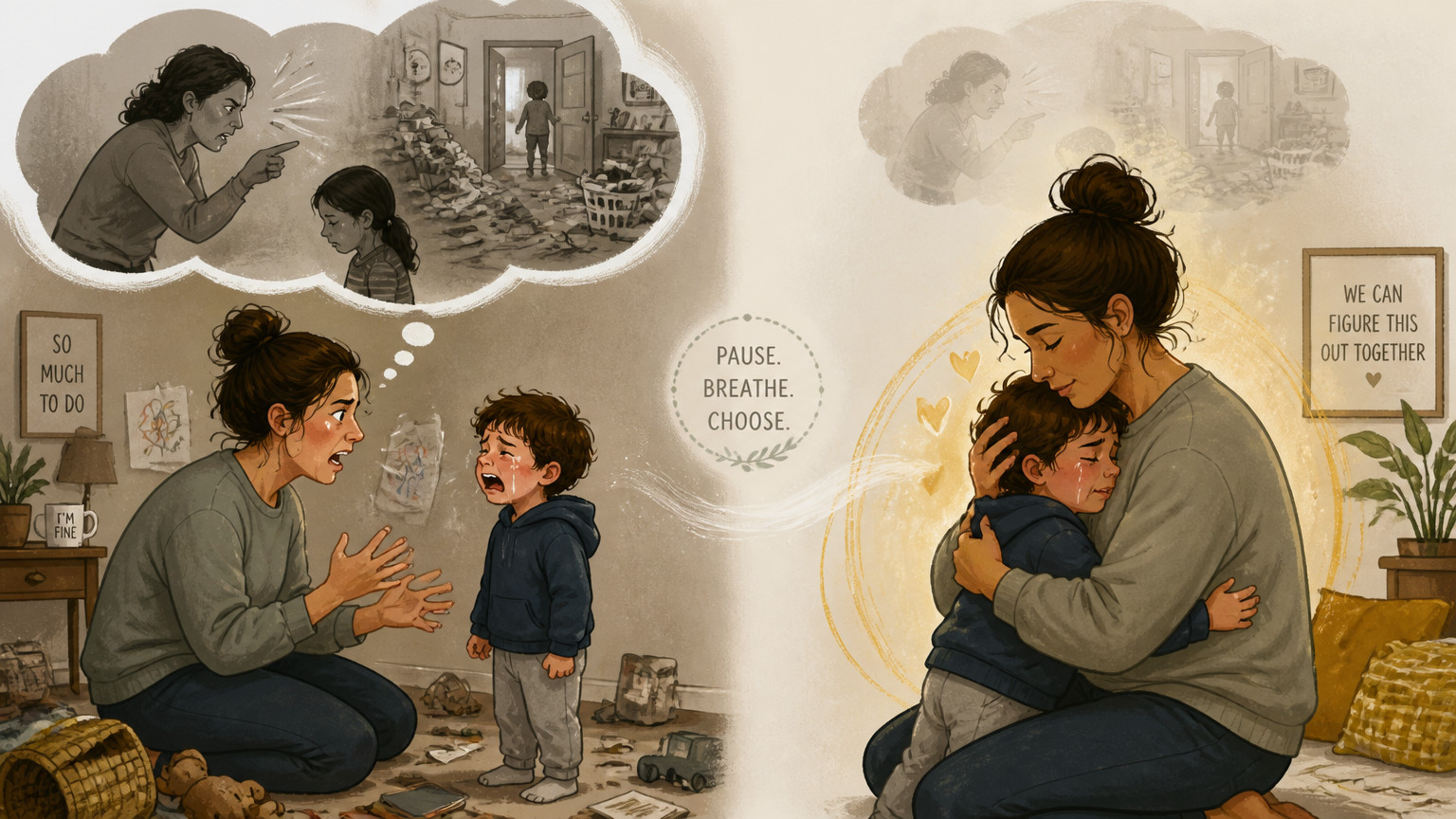
Parenting triggers catch many parents off guard. A simple moment — a child refusing, crying, or turning away — can evoke something far bigger than the situation itself. The reaction feels confusing, because it doesn’t seem to match the moment. If this has happened to you, please know: there is nothing wrong with you. Let’s gently explore what’s actually going on.
What Are Parenting Triggers?
Parenting triggers are the sudden, disproportionate emotional reactions that arise in response to ordinary parenting moments — a whine, a refusal, a slammed door. They aren’t a sign of failure. They’re a signal. And with curiosity instead of judgment, that signal can be understood rather than feared.
The Body Remembers What the Mind Forgets
Early emotional experiences aren’t always stored as clear memories. Often, they’re stored as:
- sensations
- emotional patterns
- nervous system responses
So even if you don’t consciously remember feeling powerless, unseen, or overwhelmed as a child, your body may still carry those imprints. This is part of why parenting triggers can feel so disorienting: the reaction is real, even when the memory behind it isn’t consciously available.
Why Parenting Recreates Early Conditions
Children naturally create situations that mirror early life — dependency, lack of control, emotional intensity, unpredictability. For a nervous system that once felt overwhelmed in similar conditions, these moments are not neutral. They are recognizable. And recognition triggers activation.
This is closely connected to the way the nervous system continuously scans for cues of safety and threat below the level of conscious awareness. Understanding this process can help make sense of why parenting triggers arrive with so much force, even in situations that are objectively safe.
Why the Reaction Feels So Immediate
When an old imprint is activated, the response is fast — faster than thought, faster than logic. That’s because the nervous system isn’t asking, “What is happening now?” It’s responding as though, “This has happened before.”
This isn’t a flaw in you. It’s how a nervous system is designed to protect you.
This Is Not About Blame
Understanding parenting triggers is not about blaming the past, and it is not about blaming parents — yours or your own parenting. It’s about gently recognizing that what was never processed is still active, and that parenting gives it a pathway to surface. There is no judgment in this — only an invitation to look with compassion at what’s happening beneath the surface.
Awareness Begins the Integration
The moment you begin noticing, “This feels bigger than what’s happening,” something shifts. You are no longer fully inside the reaction — you are also gently observing it. And that observation introduces space, choice, and possibility.
This kind of compassionate self-inquiry doesn’t require getting it right immediately. It simply asks you to notice, without judgment, when a parenting trigger has been activated. Sometimes, having a space to name and explore this — in a one-on-one conversation — is what allows the noticing to deepen into real understanding.
Integration Is Not Immediate
These patterns don’t dissolve through insight alone, because they’re not just thoughts — they are lived emotional experiences that were never completed. So integration happens gradually, through repeated moments of feeling, allowing, and staying present.
What Changes Over Time
If this process is allowed to unfold — without rushing, without forcing — something begins to soften. The same situations may still arise, but they carry less intensity, less urgency, less charge. The past is no longer flooding the present in the same way.
Understanding parenting triggers, gently and without judgment, is often the first step toward this softening — and it’s a step worth taking, one moment at a time.
If this resonated, you may find more here: explore more reflections on parenting and inner work.