
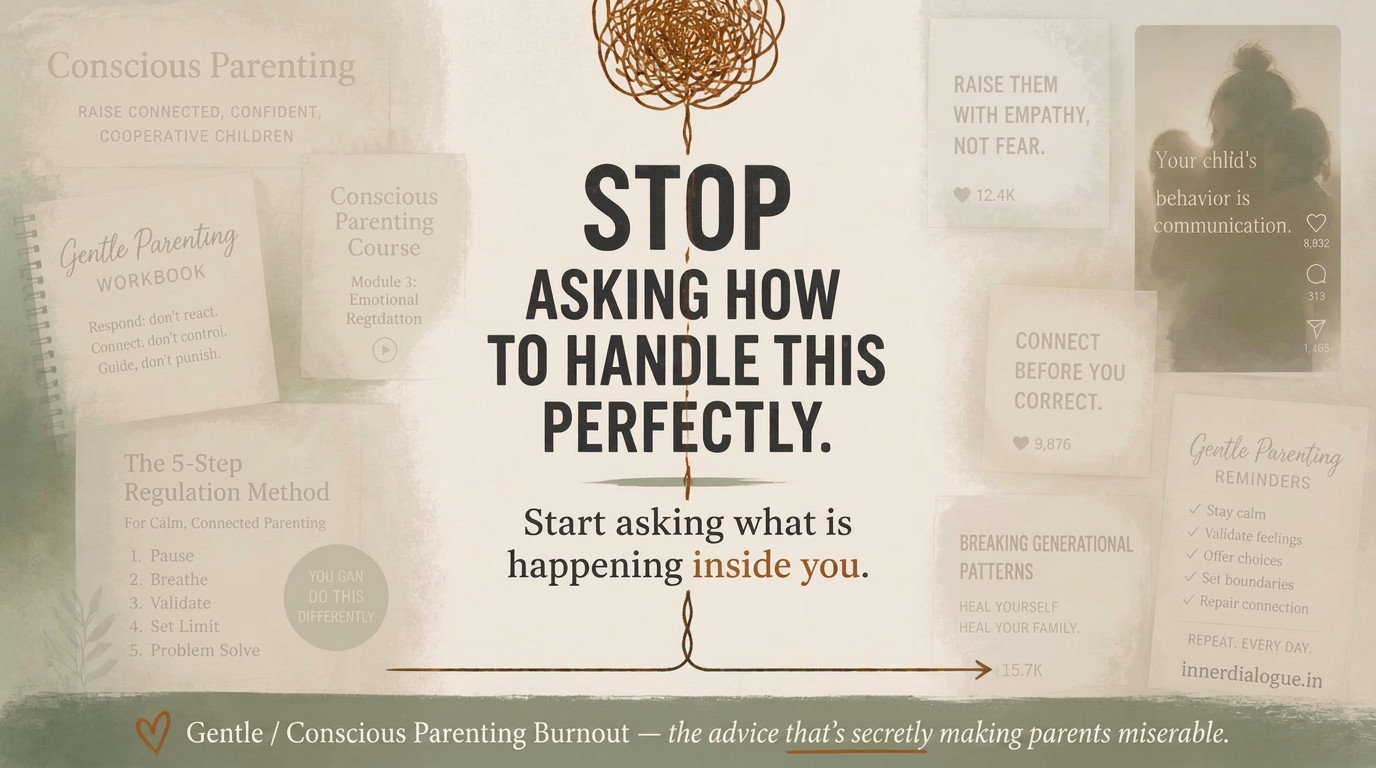
Gentle parenting burnout is real, even for parents who are doing everything the books, the reels, and the courses tell them to do.
They are not lacking effort. They are not lacking love. They are not even lacking awareness. What they are often lacking is permission to be human inside the parenting experience — because most gentle parenting and conscious parenting advice today is still operating from a subtle but powerful distortion: the belief that if you just become aware enough, regulated enough, and skillful enough, you can eliminate struggle. And that belief is quietly exhausting parents.
The Hidden Contract Behind Gentle Parenting Advice
Much of modern gentle parenting and conscious parenting advice comes with an unspoken contract: if you follow this correctly, your child will be okay — and if your child is not okay, you have missed something.
This lands very deeply in a parent’s nervous system, because now parenting is no longer just relational. It becomes a high-stakes emotional performance. Every moment starts to carry weight — this tantrum means something, this reaction will shape their future, this rupture might create long-term damage. And slowly, without realizing it, parenting shifts from presence to pressure. This is the quiet start of gentle parenting burnout.
What Gentle Parenting Burnout Does to a Parent’s Inner World
When you are constantly evaluating yourself, something subtle happens: you stop being with your child and start watching yourself with your child. There is a split. One part of you is in the moment. Another part is observing, correcting, judging — I shouldn’t have said that. That wasn’t regulated enough. A gentle parent would have done this differently.
This internal fragmentation is deeply dysregulating, because now your nervous system is not just responding to your child — it is also responding to internal scrutiny. And no nervous system can relax under constant observation.
Why “Staying Calm” Fuels Gentle Parenting Burnout
A lot of gentle parenting and conscious parenting advice emphasizes calmness — stay calm, be regulated, hold space. But what often gets missed is this: calmness that is performed is not regulation. It is suppression.
When you override irritation, silence anger, or push down overwhelm, your body does not experience that as safety. It experiences that as containment without processing. And unprocessed emotion doesn’t disappear — it stores, in the body, in the nervous system, in micro-tensions, in breath-holding, in subtle tightening. Until eventually it leaks — through tone, through sharpness, through sudden reactions that feel “out of nowhere.” And then the parent feels guilt again, and the cycle of gentle parenting burnout continues.
Researchers at the Center on the Developing Child at Harvard University have found that a dysregulated stress response doesn’t stay contained to the person experiencing it — it shapes the relational environment around them too, which is part of why suppressed calm rarely feels as safe to a child as it looks from the outside.
The Deeper Truth Gentle Parenting Advice Often Avoids
Your child is not only responding to your behavior. They are responding to your internal state. And your internal state is not something you can “fix” through scripts, because much of what gets activated in parenting is not about the child — it is about your own unresolved emotional imprints. The way you were responded to. The emotions you were not allowed to feel. The ways you had to adapt to feel safe or loved.
Parenting doesn’t create these patterns. It reveals them.
What Breaks the Cycle of Gentle Parenting Burnout
Not perfection. Not constant regulation. Not getting it right.
What actually breaks the cycle is something far more uncomfortable, and far more transformative: the willingness to stay in relationship with yourself while you are triggered. To notice — I am feeling overwhelmed right now. There is anger here that feels bigger than this moment. This reaction feels familiar, older than my child.
This is where the work shifts — from managing the child’s behavior to meeting your own internal experience.
Why This Feels So Hard
Many of us were never taught how to be with our emotions. We were taught to control them, hide them, fix them, override them. So when parenting brings everything to the surface, we try to do the same thing again — and gentle parenting burnout deepens.
But whether you call it gentle parenting or conscious parenting, this work isn’t about better control. It’s about a completely different relationship with your inner world.
The Missing Layer in Most Gentle Parenting Conversations
Awareness is important, but awareness that stays in the mind doesn’t create transformation, because these patterns don’t live in thought — they live in the body and nervous system. Which is why you can know exactly what to do, and still not be able to do it in the moment.
This is not failure. This is physiology. (You can explore more reflections like this on our blog.)
Where Real Change Begins
Real change begins when we stop asking “How do I handle this perfectly?” and start asking “What is happening inside me right now, and can I stay with it?” Not fix it. Not judge it. Not override it. Just stay.
This is the work that slowly unwinds patterns at their root. This is what creates genuine regulation — not performed calmness. And from here, your responses begin to change organically. Not because you forced them to, but because you are no longer fighting yourself internally.
If you’d like support learning to stay with what’s arising in you, rather than managing it alone, you’re welcome to book a 1:1 session.