
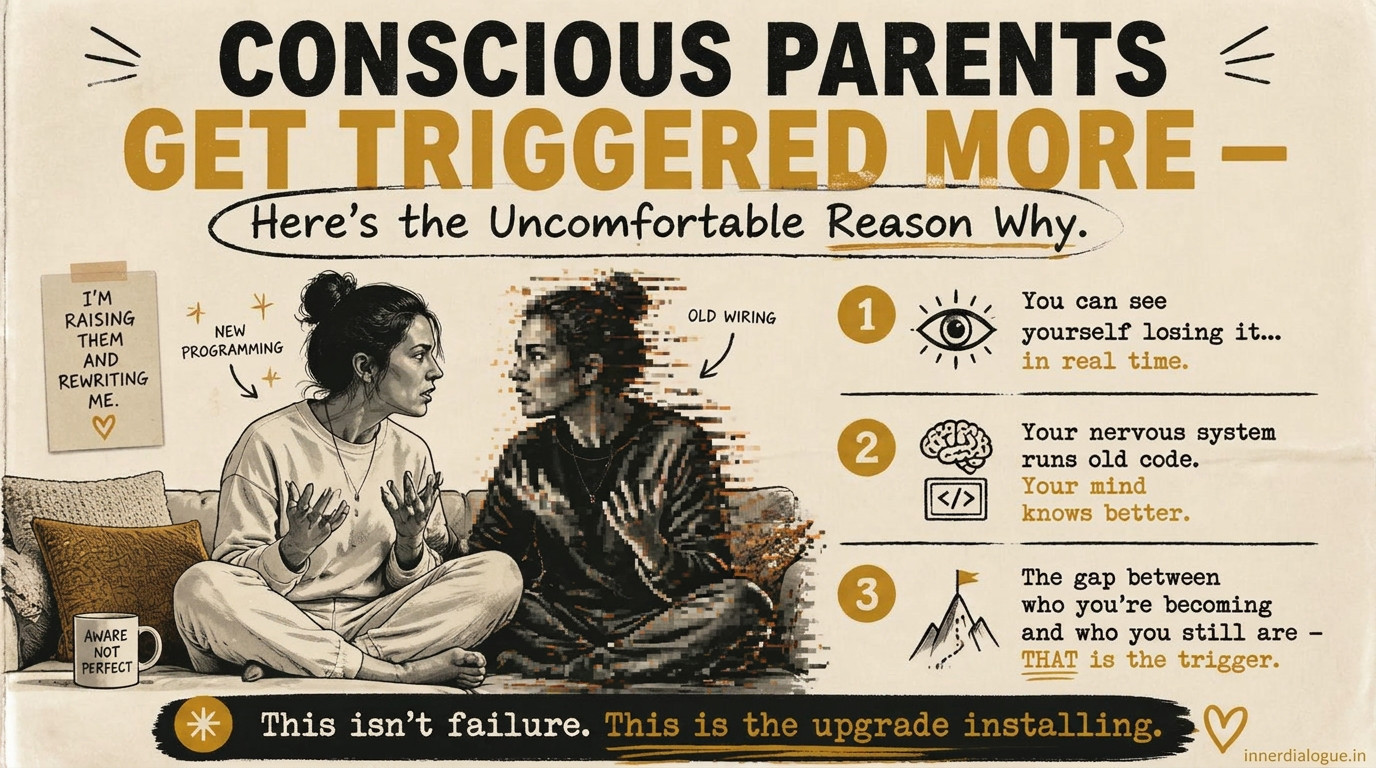
Many parents come to conscious parenting with a quiet hope.
That things will finally feel easier. That with enough awareness, they will become calmer, more patient, more in control.
And for a while, it can seem like that’s happening.
Until something unexpected begins to unfold — your parenting triggers start showing up more, not less, than ever before. If this is you right now, take a breath. This is one of the most common, least talked-about parts of the conscious parenting journey, and there is nothing wrong with you for going through it.
Parenting Triggers Aren’t Just Reactions Anymore — They’re the Awareness of Them
This can feel deeply disorienting. Because now it’s not just the reaction itself. It’s the awareness of the reaction.
Before, when your child pushed a boundary or ignored you for the tenth time, you’d react and move on. It was fast. It was automatic. You didn’t have time to notice it happening.
Now, something has changed. You catch yourself mid-reaction. You feel the heat rise before the words come out. And that noticing — as helpful as it eventually becomes — can initially feel like proof that things are getting worse.
They’re not.
Awareness Doesn’t Soothe Parenting Triggers Right Away — It Reveals What Was Always There
When awareness begins to grow, something very subtle shifts inside you. You start noticing what was always there, quietly running in the background:
- The tightness in your chest when your child resists you
- The irritation that rises before your words even do
- A surge of anger that feels bigger than the moment deserves
Earlier, these reactions moved quickly. They happened, and they passed, almost without you noticing. Now, they are visible. And what becomes visible can no longer be so easily ignored.
This is exactly why so many parents quietly wonder, “Am I getting worse at this?” But here’s the gentle truth about parenting triggers: nothing new is being created inside you. What was unconscious is simply becoming conscious. You are not falling apart. You are finally seeing clearly.
The Shock of Meeting Your Own Inner World
There’s a moment many conscious parents arrive at — a quiet, uncomfortable realization that often sounds something like:
“I didn’t know I had this much anger in me.” “I didn’t know I could feel this overwhelmed.” “I didn’t know something this small could affect me so deeply.”
Please hear this with compassion, not judgment: this is not regression. This is exposure. You are not becoming a worse parent — you are simply meeting parts of yourself that were always there, just never in the light before.
Parenting doesn’t only ask you to respond to your child in front of you. It repeatedly places you in situations that activate your nervous system — often in ways that quietly mirror your own earliest emotional experiences, long before your child was ever born.
Why Parenting Triggers Activate So Much in Us
Children, simply by being children, create conditions that are neurologically potent for an adult nervous system:
- A lack of control over outcomes
- Emotional intensity, again and again
- The repetition of demands, requests, and needs
- Dependency and constant interruption
For a nervous system already carrying unresolved emotional material from your own past, these are not neutral, everyday experiences. They are activators — not of thought, but of stored emotional memory that has been waiting, patiently, to be noticed.
Parenting Triggers Are Not Stories — They’re Sensations
Most parents expect healing to arrive through understanding. There’s a common belief: “If I know why I react this way, I can simply change it.”
But here’s something gentler and more honest: much of what gets activated in parenting isn’t cognitive at all. It’s somatic — meaning it lives in the body, not just the mind. It can show up as:
- A tightening in the chest or throat
- A sudden surge of heat through the body
- A collapsing feeling of helplessness
- A restless urgency to “make this stop” right now
These aren’t only reactions to what’s happening in front of you in this moment. Often, they’re echoes — of past emotional experiences that were never fully processed or given the space to complete themselves.
Why This Difficult Phase Is Actually Good News
Even though it feels overwhelming, this phase of your parenting journey is profoundly significant. Because for the first time, you’re not just reacting to your parenting triggers. You’re witnessing the reaction as it happens.
And that witnessing creates space — a small but real gap between the activation and the action. Inside that gap, something new becomes possible, perhaps for the very first time.
The Real Opportunity Hidden Inside Every Parenting Trigger
Every trigger carries information. Not about what your child is doing “wrong.” But about what is still unresolved within you.
If you approach this with judgment toward yourself, the cycle tends to continue and repeat:
Reaction → Guilt → Suppression → Build-up → Reaction
But if you can meet yourself with curiosity instead, something begins to shift:
Reaction → Awareness → Presence → Integration
This is the quiet, often invisible place where real parenting transformation begins. Not by managing your child better, but by allowing parenting to gently reveal you to yourself.
Conscious Parenting Isn’t About Having Fewer Parenting Triggers
Here’s where many parents get gently misled. There’s an assumption that the goal is fewer reactions, less anger, more calm — as fast as possible.
But conscious parenting isn’t really about eliminating triggers. It’s about changing your relationship to being triggered in the first place.
It’s the shift from “I shouldn’t feel this” to “Something in me is asking to be seen.”
That single shift, small as it sounds, changes everything about how the rest of this journey feels.
The Path Most Parents Don’t See Coming
The deeper you move into conscious parenting, the less it actually becomes about your child. And the more it quietly becomes about:
- Your own emotional capacity
- Your nervous system, and how it holds tension
- Your relationship with discomfort itself
This is precisely why many parents feel like it’s getting harder before it gets easier. Not because something is going wrong — but because you are no longer bypassing yourself the way you may have for years.
Where This Leads, If You Stay With It
If you stay with this process — not trying to fix it overnight, not trying to become a perfectly calm parent — something begins to soften over time.
The intensity reduces. The reactions slow down. Not because you white-knuckled your way into controlling them, but because the emotional charge sitting beneath them is finally allowed to dissolve.
If you’d like more gentle, judgment-free reflections on parenting triggers like this one, you’ll find more conscious parenting insights over on Inner Dialogue’s blog, written for parents who are learning to meet themselves with the same compassion they hope to offer their children.
And if you feel like you could use a space to actually sit with what’s coming up for you — not just read about it, but be gently guided through it — you’re welcome to book a one-on-one session here. Sometimes it helps enormously to not have to walk through this alone.
You are not doing this wrong. You are doing something far braver than staying unaware ever was.